Contents
- In a nutshell
- Where to start?
- Choosing a religion.
- Turning point – Dec 2005
- Great Leap Forward – 2021
- Mindfulness, Meditation and not Me
- Where now?
In a nutshell
This would be a quick summary of this entire post. So that, if you are interested in certain sections, you can jump to that section.
“Where to start?” is about the beginning of my journey in Buddhism in secondary school (year/grade 7 or 8 onwards). Of how taking “Buddhist Studies” as an “O” level subject kindled the interest in Buddhism.
“Choosing a religion” talks about a time when I decided that I should properly choose a religion and how this started my learning about various religions. And how, in the end, I chose to be “inclining towards Buddhism”.
“Turning point – Dec 2005” is about how my first trip to India, resulting in some unintentional incidents, which made me change from “incline towards Buddhism” to a Buddhist.
“Great Leap Forward – 2021” is how I took up the Diploma in Buddhism kind of due to Covid-19, and from it, how I better understood Buddhism and its teachings.
“Mindfulness, Meditation and not Me” is my journey in mindfulness and meditation, how I personally differentiate these 2 terms as well as Vipassana Meditation.
“Where now?” is a simple conclusion about where I think I am in this journey of Buddhism.
Where to start?
Based on memory, I started my learning of Buddhism very early on in secondary 1 or secondary 2 (for my non-singaporean readers, that would be grade 7/8 or year 7/8). That time, I was just learning bits and ends here and there. Could not remember what made me even start learning about Buddhism though.
During my secondary school days, there was an option to take up Religious Knowledge (RK) as an “O” level subject. This is an optional subject and not compulsory during my time. Before my time, it was compulsory. After my time, it was taken away totally.
I chose to take up “Buddhist Studies” as an “O” level subject. I was the only student from my school that took up “Buddhist Studies”. My secondary school did not offer “Buddhist Studies”, so, I had to travel to another secondary school for the lessons. I did this quite consistently for secondary 3 (grade/year 9), but for secondary 4 (grade/year 10), I did not travel to the other school for lessons.
I cannot remember exactly why I did not travel to the other school for lessons. Was it because the teacher teaching the subject told me that I could self-study instead or was I too lazy or both reasons?
I got an E8 for the “Buddhist Studies” for the “O” levels. The grades are A1 to F9, where a pass is usually C6 and above. So, an E8 is a fail.
Though, I got an E8, “Buddhist Studies” was the start of my pursuit in learning Buddhism with its formal lessons.
Before “Buddhist Studies”, it was just learning here and there, where possible and not very structured. After “Buddhist Studies”, and its formal lessons, it ignited an interest in Buddhism through listening to the stories, explanations and interactions with the teacher.
I tend to learn better through formal lessons, asking questions and interacting around. Maybe that is why you would see me asking a lot of questions and paraphrasing even while talking with friends.
However, after “Buddhist Studies”, there wasn’t another chance for me to interact or ask someone questions. So, it was basically, just self studying here and there, inconsistently. This would continue until December of 2005. But before December of 2005, there was that time during my early 20s.
Choosing a religion.
I had always been fascinated by religions in general. Studying in a Catholic school for 10 years, allowed me to see some parts of Catholicism. I had also read the Bible at times for the stories, so I knew some Christianity.
When I was in my early 20s, I decided that I should choose a religion, and to do that, I needed to be fair to the major religions and learn about each of them.
Yes, I know this is very uncommon way to enter a religion. This is just how systematic my mind thinks.
Besides Buddhism, Catholicism and Protestant Christianity, I did not know much of the other religious.
I borrowed a beginner’s book about Islam from the library, and was fascinated how Islam started off, comparing that to how it had evolved to the Islam of today.
For Hinduism, I understand that the Ramayana and Mahabharata were 2 epics that Hindus should read about. So, I read a simplified version of the Ramayana and had a gist of what the Mahabharata was about.
After reading and understanding as best as possible, each of the religions, I realised that there was faith in each of them, except Buddhism. You needed, at some level, to just have faith and believe. There is only so much you could question in the other religions except Buddhism.
In Budddhism, instead, you are encouraged to question the teachings, and reflect to find the answers yourself. It is because of this main reason, that I chose to “incline towards Buddhism”.
Why only “incline towards Buddhism”? It is because there are certain aspects of Buddhism that I did not fully understand.
If I did not choose to “incline towards Buddhism”, I might have become a Muslim. The origins of Islam were very liberal and allowed one to explore the depths of the religion, that’s why the early pioneers in many areas, for example, mathematics and astronomy, were Muslims. Our current number system has its origins from the early Muslim mathematicians. Of course, the current Islamic landscape is a bit different.
Turning point – Dec 2005
I am quite excited to write about this chapter in my Journey in Buddhism, as this was where I became “inclined towards Buddhism” to, accidentally, a Buddhist.
Till 2005, I knew generally of both Theravada Buddhism (Note: DO NOT use the term Hinayana Buddhism, as it is meant to demean Theravada Buddhism), and Mahayana Buddhism. I knew of the existence of Vajrayana (or Tibetan) Buddhism but did not have any knowledge or details of it. It was through my first trip to India in Dec 2005 that allowed me to learn more about Tibetan Buddhism.
Before that, I have to first go to June of 2005. In June of 2005, I visited Kuala Lumpur and there, while in a temple, I chatted with a Malaysian there. Our chat then discussed about Buddhism, and he mentioned that he is going to India in Dec 2005. Since, I am “inclined towards Buddhism”, I was keen as I didn’t know what are the various means to visit India. I asked to join his group, to which, he allowed me to join the trip.
The trip was going to be 3 weeks long, from the middle of December to the first week of Jan. That was the year when I left the teaching service, which also allowed me to join this trip.
In the months leading up to this trip, my friends were concerned about me going to India with 4 others who I don’t know anything about. This was the time when emails were circulated about people being drugged and had their organs cut out and sold. Despite all these, I still decided to go for this India trip.
Somehow, in the age of mainly emails, when handphones were still new, and WhatsApp was not free yet and not widely used, the organizing of the trip did pull through and I was on my way to India.
I don’t even remember the names of my 4 other fellow travels mates now. At the airport, I met 3 of them for the first time, and the oldest guy, who was the person who I met in Kuala Limpur, the second time. There were 3 guys, including myself, and 2 ladies. The oldest guy was about in his late 40s, the other guy was in his mid-30s and myself who is in my late 20s. One of the ladies was also about mid-30s and the other lady was around my age. The oldest guy and the young lady were Malaysians and the rest of us were Singaporeans.
In India, we were met by a Lama (Tibetan Monk), in his 30s, who was able to speak English. Along the way, another Lama, in his 40s, joined us, who was able to speak Mandarin Chinese. The Lamas were going to be our tour guides for this India trip. They helped to arrange the transport, the driver, and helped to communicate with the locals when needed.
With 2 Tibetan Lamas around, this gave me the opportunity to ask more about Tibetan Buddhism. The problem was that I knew my Buddhism terms in English, but the younger Lama is not very well versed in doctrine, whereas the older Lama was well versed in doctrine but could only converse with me in Mandarin Chinese.
I remember one night at a guest house, where the 3 of us was sitting down for the evening. The young lama would be the translator for myself and the older Lama using Tibetan and English. I would be asking questions about Buddhism and Tibetan Buddhism in English and trying to find the correct terms in Mandarin. The older Lama would try to explain in Mandarin and if I didn’t understand, the younger Lama would find out in Tibetan and translate for me in English. It was an interesting conversation, but I was able to better understand Tibetan Buddhism during the course of the trip.
I am very intrigued and fascinated by Tibetan Buddhism’s “debate”, where one monk would be an advocate of Buddha’s teachings, while the other monk would be Devil’s advocate. They would then debate on a certain topic. If Buddha’s teachings are true, then in any debate, the monk advocating Buddha’s teachings should prevail unless the monk’s understand of the teachings is insufficient. In such a case, a more senior monk would then come in and advocate for the Buddha’s teachings. As a teacher, I can totally understand the rationale of this “debate”, and how each participant and even onlookers would benefit greatly, in terms of understanding Buddha’s teachings.
On this trip, I was expecting to be mainly visiting the main Buddhist sites, which the group did visit but it did not seem to be the main focus of the trip. The main focus of the trip seems to be visiting high ranking Lamas and getting the blessings of these high ranking Lamas, while visiting the Buddhist sites along the way.
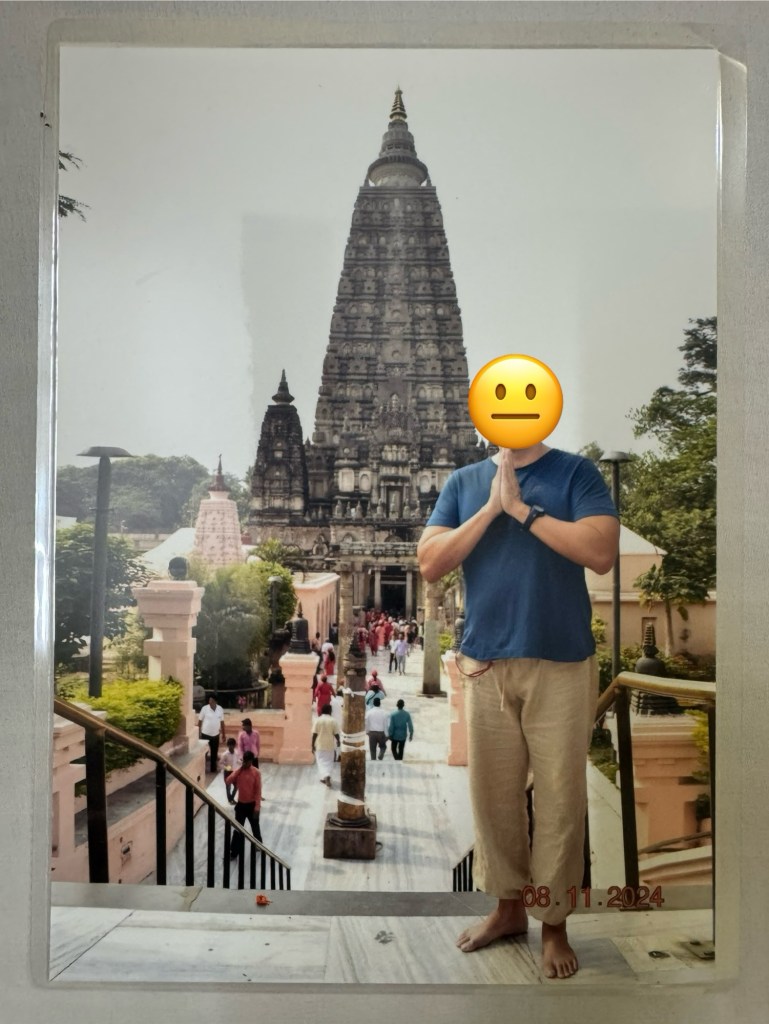
I have no complaints about the arrangement of the trip as such, since I got to see a very different side of India, which I doubt many others have seen. But, of course, due to the lack of spending quality time at some of the Buddhist sites, I had always wanted to go back to India again, which I did in November 2024.
The perks of this trip, I did get to meet high ranking Lamas while in India. I do not know any of these high ranking Lamas, but after this trip, and doing some research, then I found out how high ranking these Lamas are.
One of the high ranking Lamas, that I met is one of the 17th Karmapa. (There are 2 17th Karmapa, you can go read up on this.)
Before the audience with the 17th Karmapa, the group had requested to seek refuge under him during the audience. I declined to seek refuge but would observe the ceremony. Seeking refuge is a simple ceremony, which affirms one’s commitment to be a Buddhist.
However, during the audience with the Karmapa, I was somehow included in the seeking refuge ceremony. So, funnily, I was “accidentally” confirmed as a Buddhist.
I have no regrets for “accidentally” becoming a Buddhist. In a way, it totally changed my perspective of things, and allowed me to move forward in my journey in Buddhism. Before becoming a Buddhist, I was always sitting on the fence, eyeing the side of Buddhism, but still giving myself a chance to jump elsewhere. But, due to that, sitting on a fence, doesn’t get you anywhere. I was just seeing the view from the top of the fence. By “accidentally” becoming a Buddhist, I was forced off the fence, but found my legs to walk forward on my Buddhism path.
After our seeking refuge ceremony, we were given refuge names.
The 17th Karmapa was given a stack of refuge names, and he flipped through the names before deciding which refuge name for who. Somehow, considering that he doesn’t know us at all, I thought he chose some very apt refuge names for us.
For the oldest guy, his refuge name is that of a previous Karmapa. The other guy, in his mid 30s, his was that of a protector, which I thought was very apt, since he was like our bodyguard. The lady in her mid-30s was given a refuge name related to money, which I also thought was very apt, since she was an accountant, by profession, and was the treasurer of our trip. The young lady was given the refuge name of a female deity.
Myself, my refuge name was related to wisdom and knowledge, which I thought was also very apt, since I do enjoy the pursuit of knowledge.
After this trip to India, after becoming a Buddhist, I tried to learn more about Tibetan Buddhism, but there is only so much I can learn about Tibetan Buddhism in Singapore. And, Tibetan Buddhism has lots of rites and rituals, which because I am new to it, I am usually very lost when I join their rites and rituals.
The next chapter explained how I was able to leap forward in my journey in Buddhism.
Great Leap Forward – 2021
If Covid-19 didn’t not happen, I don’t think I would have been able to leap further forward in my journey in Buddhism.
Due to Covid-19, the whole world stopped travelling. If you know me personally, you would know that I travel a lot, a lot. So, when a friend, who is new to Buddhism, asked me to join him in studying for a Diploma in Buddhism, I agreed to it, since I wouldn’t be able to travel anyway.
This Diploma in Buddhism is from the Pali Buddhist College in Sri Lanka, conducted in Mangala Vihara, a Sri Lankan Buddhist Temple in Eunos, Singapore.
The Diploma in Buddhism has 5 subjects, namely:
- Early History of Buddhism
- Geographical Expansion of Buddhism
- Buddhist Social Dimensions
- Basic Doctrine
- Pali Qualifying Paper
Before this Diploma in Buddhism, the sutras that I am aware of were the Mahayana Sutras, namely the Lotus Sutra, the Heart Sutra, the Diamond Sutras, etc. Note that I have only heard of these sutras, but never got around to read most of them. The only one sutra which I have actually read is the Heart Sutra.
During the Diploma in Buddhism, I got to know about the early Buddhist Suttas, and the directness and simplicity of the early Buddhist Suttas. Clear step by step instructions are given for all aspects of life, from who to make friends with, how to treat one another, how to spend one’s money, what to follow, how to gauge what to follow, etc, are all in the early Buddhist Suttas. All for the purpose of one’s happiness.
Here, let me explain why the spelling of sutra and sutta. Sutra is the Sanskrit spelling for sermon/teaching, as most, if not all, the Mahayana Sutras were written in Sanskrit. Sutta is the Pali spelling for sermon/teaching, as the early Buddhism Suttas were orally transmitted in a language similar to Pali and then later written down in the Pali Language.
The early Buddhist Suttas opened a different dimension of Buddhism. If I have to compare the Suttas/Sutras/teachings of the 3 schools of Buddhism, this is how I would compare them:
- The early Buddhist Suttas were like teaching one the basics from primary school, secondary school, pre-university and the university syllabus.
- The Mahayana Sutras were like giving you the university syllabus to learn straight away.
- The Tibetan Buddhism system is like you having the innate university syllabus in you already, and through the Tibetan Buddhism system, you are directed on how to bring out the full potential of this innate university syllabus.
Hence, with the reading, learning and understanding of the early Buddhist Suttas, I was able to better piece together the Mahayana Sutras and the Tibetan Buddhism system. This allowed me to leap further in my journey of Buddhism.
After the Diploma in Buddhism, I did continue for the first year of the Degree in Buddhism, but the subjects in the first year wasn’t where my interests lay. Or maybe that’s an excuse, and my wanderlust was resurfacing due to the opening up of the world. I wanted to travel again. I attended the whole year of lessons of the first year of the Degree course but did not take the exams.
All in all, Covid-19 became a blessing for me to re-energise my journey in Buddhism.
Mindfulness, Meditation and not Me
I started trying out meditation in my secondary schooling days, by reading books and just practicing it.
For a start, I would be using the term meditation. Later in this section, I would explain how I would personally categorise the terms, Mindfulness, Meditation and Vipassana Meditation.
From the books on meditation, there are lots of things to take note of. You need to take note of how you sit, how your body is erect and yet supple, how to hold your hands, how to adjust the angle of your head, how to keep your eyes slightly open, how to place your tongue in your mouth, etc. Besides taking note of one’s body posture, one would then need to also focus on one’s breathe.
So, being the systematic person, I would try my best to take note of ALL the points, but it is difficult!! Very difficult!! There are too many things to take note of!! So, I could not do much meditation properly, since I was so occupied with all the different aspects of it.
Through the years, I did attend some short courses on meditation, and was taught to just be mindful of your actions. So, after sometime, instead of practicing meditation, I was just trying to be more mindful in my daily life in general.
The breakthrough came when I was introduced to a Vipassana Meditation Centre in Chiang Mai, Thailand. I was intrigued about this meditation centre as it taught Vipassana Meditation. I had heard of Vipassana Meditation before this, but never got a chance to fully understand or learn it.
Vipassana means insight. Vipassana meditation then means insight meditation. Wow, I would be learning how to gain insight if I go to this Vipassana Meditation Centre in Chiang Mai, Thailand.
I booked my trip, accommodations and headed to the Vipassana Meditation Centre in the January of 2019 for a 7 days retreat.
This was a noble silent retreat meditation centre, meaning that one is not allowed to talk, sing, listen to music, use your mobile phones, nor any entertainment during the retreat. I was ready for it, planning to journal my experience during the retreat and reading up on Buddhism in my free time.
On the first day, we were taught how to meditate by a monk. I was ready. I was going to learn how to gain insight. However, I was taught with very little instructions, even lesser instructions given compared to the previous meditation classes that I have attended. Basically, the simple instruction was, just sit and focus on your breathing, that’s all.
I was also taught walking meditation on that first day. We were expected to do both walking and sitting meditation. Walking meditation was new to me. The instructions was also equally simple, just walk slowly for a distance, stop, then turn around, stop, then walk for a distance. Right leg. Left leg. Stop. Turn. Stop. Right Leg. Left leg. Right leg. Left leg. Stop. Repeat.
On the first day, we were also told the rules, which included no reading or writing. Oh, I didn’t know that.
Each day, after lunch, we would meet with a monk, who would then guide us to the next stage of walking and sitting meditation. He also taught us some lying down meditation, which we are to practice before sleeping each night.
During the days of meditating, my mind would be whirling with all the thoughts and experiences of the retreat, but I couldn’t pen them down. I left the retreat after 6 days to properly pen down my thoughts. (You can check out my thoughts about the retreat in another post.)
In the midst of all this, I was just thinking, Vipassana Meditation does not seem any different from the meditation that I have read and attended. Where was the insight? Was it lost in translation?
After my diploma in Buddhism, I came back to this Vipassana Meditation Centre again in the November of 2022. It was then I realised what the monks are trying to teach in terms of meditation.
The Buddha had taught that we need to be mindful in 4 states: sitting, walking, standing and lying down. So, by doing walking meditation for a distance , stopping to stand, then being mindful of standing, before turning, and continuing, one was practising both walking and standing meditation. So, including the instructions for lying down meditation, we were taught how to be mindful in these 4 states.
I would explain what I personally understand as Mindfulness, Meditation and Vipassana Meditation. Do note that this is my own personal interpretations and might be wrong. Do discuss with me if my thoughts on these differ from yours.
- Mindfulness.
EVERYTHING that I have learnt and/or read about from secondary school, the various meditation courses I attended, meditation retreats I attended, are all about learning Mindfulness.
Through learning how to focus on one’s breathing, one can be mindful of our daily activities in the 4 states, sitting, walking, standing, and lying down.
This helps when for example, one is angry at something. Then by mindful and knowing that one is angry, one can then decide what one should do next. In the case of anger, for most people, they get angry, and then lash out in the midst of anger. With mindfulness, one is then better aware that one is angry, which helps one identify better the next course of action.
Mindfulness is vital and core for both Meditation and Vipassana Meditation.
- Meditation.
This is just my personal usage and understanding of the term Meditation.
For me, Meditation comes with reflection.
In the case of one becoming angry, when one has cooled down, then one can meditate on the situation, by reflecting. Was one’s actions right? What are the causes for one’s anger? What should one do in future similar situations that makes one angry? Etc, etc.
Only when one has learnt what is being mindful, then one can better reflect and meditate.
After one’s reflection in meditation, one’s issues might not be resolved, but at least one has better understood some aspects of it.
One can also meditate on the teachings of the Buddha, reflect on the teachings to see and better understand them.
For me, meditation comes with both doing mindfulness and reflection.
- Vipassana Meditation.
This is again, my own understanding of Vipassana Meditation.
From interacting with friends, and teachers about Vipassana Meditation, the basis is still Mindfulness.
Through constant practice of Mindfulness in all states, sitting, walking, standing, lying down, one can then innately perceive the essence of things. Sorry, if I am being abstract here.
Let me try to explain it.
For the case when one becomes angry, when one is able to be mindful that one is angry, certain revelations could also result just from being mindful that one is angry. These are just sudden revelations, and not the conscious reflections of Meditation. These sudden revelations are the Insight/Vipassana that one has achieved by being mindful that one is angry,
Vipassana Meditation would help us perceive things as they are by doing our Mindfulness practice.
Of course, I have not gotten much insight yet, so that’s about as far I can explain Vipassana Meditation.
For those, thinking of trying out Mindfulness/Meditation, my advice is to just try it. When you are met with obstacles, then try to find someone to help overcome your obstacles.
I am not practising Mindfulness/Meditation as much as I should, but I think I am headed towards the correct direction.
Where now?
Noting that these are my current views as of November 2024. With the continual learning of Buddhism, views and perspectives might change, as I better understand the teachings.
Growing up in Singapore, I have had great influence from Mahayana Buddhism, where most of the prominent temples in Singapore are of Mahayana Buddhism.
While in India, I sook refuge under Tibetan Buddhism, and was able to come into close contact to learn about Tibetan Buddhism.
My Diploma in Buddhism, allowed me to learn more about the early Buddhist Suttas and Theravada Buddhism in general. Theravada Buddhism uses the early Buddhist Suttas as its basis for teaching and learning.
All in all, I see benefits in all schools of Buddhism. I used to segregate the 3 schools of Buddhism, but after interacting with different monks and nuns, I learnt that ultimately, there are NO 3 schools of Buddhism. There is only the path of happiness for all in Buddhism.
As some friends know, I have thoughts of becoming a monk when I retire. However, things have changed.
From India, I got to know a Singaporean who became a Lama (Tibetan Monk) for a number of years, de-robed to become a lay person, and is now happily married. I asked him for his opinion of becoming a monk. His advice was that as a layperson, we can also achieve as much as a monk. Of course, the path is harder with all the daily distractions and needs, but it is still possible.
Thus, my current stand is to continue my own practice to the best of my abilities as a lay person.
The Buddha taught that there are 4 types of people in Chavālātasutta (Aṅguttara Nikāya 4.95) https://suttacentral.net/an4.95/en/sujato
- One who neither helps oneself nor others: Compared to smoldering dung, this person is of no benefit to themselves or others.
- One who helps others but not oneself: They help others but fail to develop themselves, akin to a lamp that gives light to others but eventually burns out.
- One who helps oneself but not others: Focuses solely on self-improvement but doesn’t assist others, akin to someone eating their own food but not sharing it.
- One who helps both oneself and others: Praised as the ideal, this person works for their own welfare while also supporting and benefiting others.
(The first type of person) The person who practices to benefit neither themselves nor others is like smoldering dung.
(The second type of person) The person who practices to benefit others, but not themselves, is better than that.
(The third type of person) The person who practices to benefit themselves, but not others, is better than both of those.
(The fourth type of person) But the person who practices to benefit both themselves and others is the foremost, best, chief, highest, and finest of the four.
From this teaching, ideally, we should strive to help both oneself and others, but if one is unable to help others, then one should at least try to help oneself first.
I feel that some Buddhists try their very best to help others but forget to first help themselves, thus burning out. (The second type of people)
In terms of my own studies and learning, I am re-reading some of the early Buddhist Suttas which Theravada Buddhism follow closely. I feel that this is important to me, to regularly review and re-learning.
While in the midst of reading the early Buddhist Suttas, the drive of the Mahayana Buddhist to constantly help others is admirable, and I wish to emulate where possible.
I would also like to form a group of like-minded friends to practise Tibetan Buddhism’s “debate”. This is just a current thought, yet to be established.
About my current views on Mindfulness and Meditation:
My current view is that through Mindfulness practice, one can be mindful of one’s body, feelings, perceptions, habits, and of the 5 senses. However, being mindful does not resolve many of the conflicts and struggles that one faces, specifically mental conflicts and mental struggles.
I believe that one has to do Meditation, reflecting, with the understanding of the teachings of the Buddha, to then properly resolve one’s mental conflicts and struggles, to then achieve happiness.
For Mindfulness/Meditation, I am trying to make it a regular practice, but not finding much success yet. Would continue to strive harder in my Mindfulness/Meditation exploits. Wish me luck!!
May all sentient beings be well and happy. Sadhu Sadhu Sadhu.

 Will travel